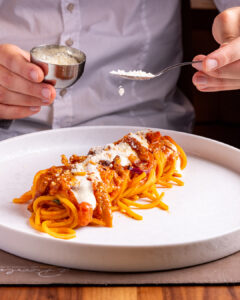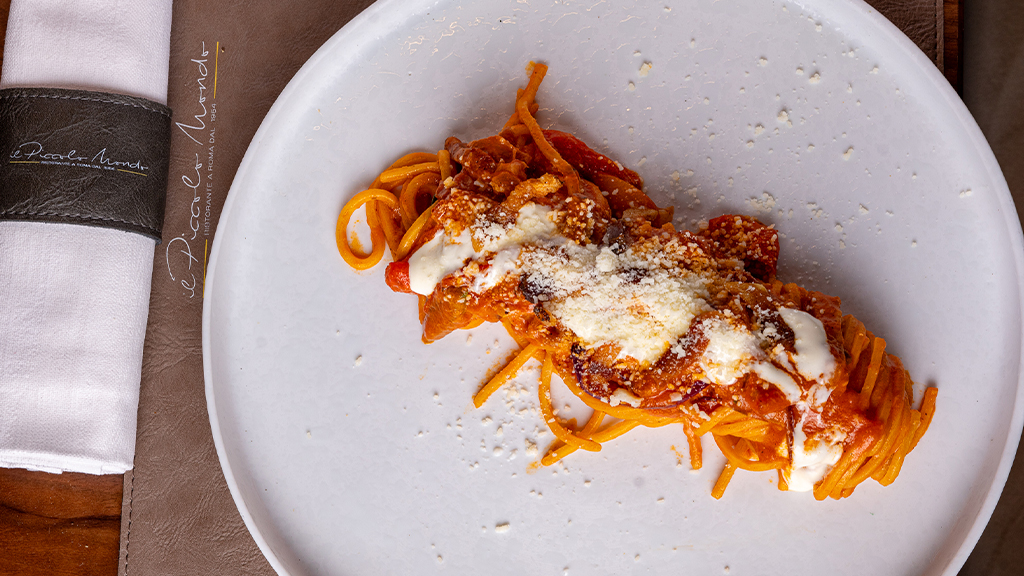
Pasta all’amatriciana is one of the most representative dishes of Lazio’s gastronomic tradition, known for its bold flavor and the perfect balance between its various ingredients.
But what is its true origin? And why, despite being considered a symbol of Roman cuisine today, does its history begin far from the capital?
The origins of amatriciana: a story tied to the life of shepherds
As the name suggests, amatriciana was born in Amatrice, a town now located in the province of Rieti, but which administratively belonged to Abruzzo until 1927. Its origins are closely linked to the lives of shepherds and transhumance, the seasonal movement of flocks to more favorable pastures.
During these long journeys, which could keep shepherds away from home for up to four or five months, it was necessary to carry nutritious foods that could be stored for a long time. Cured guanciale, pecorino cheese, flour, and dried pasta were among the most used ingredients. With these few products, they prepared a substantial meal, easy to cook even while on the move.
The original recipe was tomato-free and was called gricia, considered the ancestor of amatriciana.
From gricia to amatriciana: when does the tomato arrive?
One of the most interesting fun facts concerns the evolution of the recipe itself. The tomato, which arrived in Europe after the discovery of America, was initially not used as food. Its spread in Italian culinary preparations happened gradually, especially between the eighteenth and nineteenth centuries.
The inhabitants of Amatrice, whose territory was historically also linked to the Kingdom of Naples, were among the first to experiment with its use in cooking. The addition of tomato to the original preparation based on guanciale and pecorino gave life to the red version we know today.
One of the first written records of using tomato sauce to dress pasta appears in 1790, in the manual L’Apicio Moderno by the Roman chef Francesco Leonardi. It is precisely this evolution that marks the birth of one of the most famous pasta sauces in Italian gastronomy.
How did amatriciana end up on Roman tables?
The success of amatriciana is also tied to the relationship between Amatrice and Rome, consolidated over the centuries. Between the nineteenth and twentieth centuries, many inhabitants of Amatrice moved to the capital in search of new job opportunities. Many of them found employment in the restaurant business and opened osterias and eateries where they offered the recipes of their homeland. From this arose a linguistic curiosity: restaurateurs coming from Amatrice were called matriciani. The term eventually became associated with the inns that served this type of cuisine as well. And so the recipe spread more and more throughout the capital, becoming part of the tradition of Roman trattorias. Despite having Amatrician origins, it has become over time one of the most representative dishes of the capital’s gastronomy.
What are the ingredients of the real amatriciana?
The strength of this preparation lies in the simplicity and quality of its ingredients. Each ingredient contributes to creating a precise balance.
- Guanciale: cut into strips and browned until golden, it releases its natural fat and gives character to the sauce;
- Tomato: adds freshness and a pleasant acidic note, balancing the savoriness of the other ingredients;
- Pecorino Romano: with its intense taste, it completes the preparation and contributes to the creaminess of the sauce;
- Black pepper: adds an aromatic component that enhances the other flavors.
The choice of pasta is also important. Bucatini is probably the pasta shape most associated with amatriciana, thanks to its elongated form and characteristic central hole. However, the recipe also lends itself to other shapes, such as spaghetti and rigatoni.
Care in the selection of ingredients and the correct preparation process are essential to achieving a balanced result, without altering the identity of a dish so deeply tied to the history of the territory.
Where to eat pasta all’amatriciana in Rome?
If you want to rediscover the flavors of tradition, Il Piccolo Mondo awaits you at Via Aurora 39, just steps away from Via Veneto and Villa Borghese.
The restaurant’s kitchen offers traditional Italian and Roman recipes, with attention to the quality of raw materials and the care taken in every preparation.
On the menu, you can find pasta all’amatriciana in its classic version, with the bold taste of guanciale, tomato, and pecorino, or try a fresher and more delicate variant, enriched with cherry tomatoes and burrata, for a meeting of different flavors and textures.
Two different interpretations, united by the quality of the ingredients and the desire to bring to the table offerings capable of satisfying different tastes.
Come visit us and let yourself be captivated by the great classics of Italian cuisine! Book now.